Pope Leo XIV warns against destructive spiral of autonomous weapons and escalation
 Jim C Salonoy - News Moderator
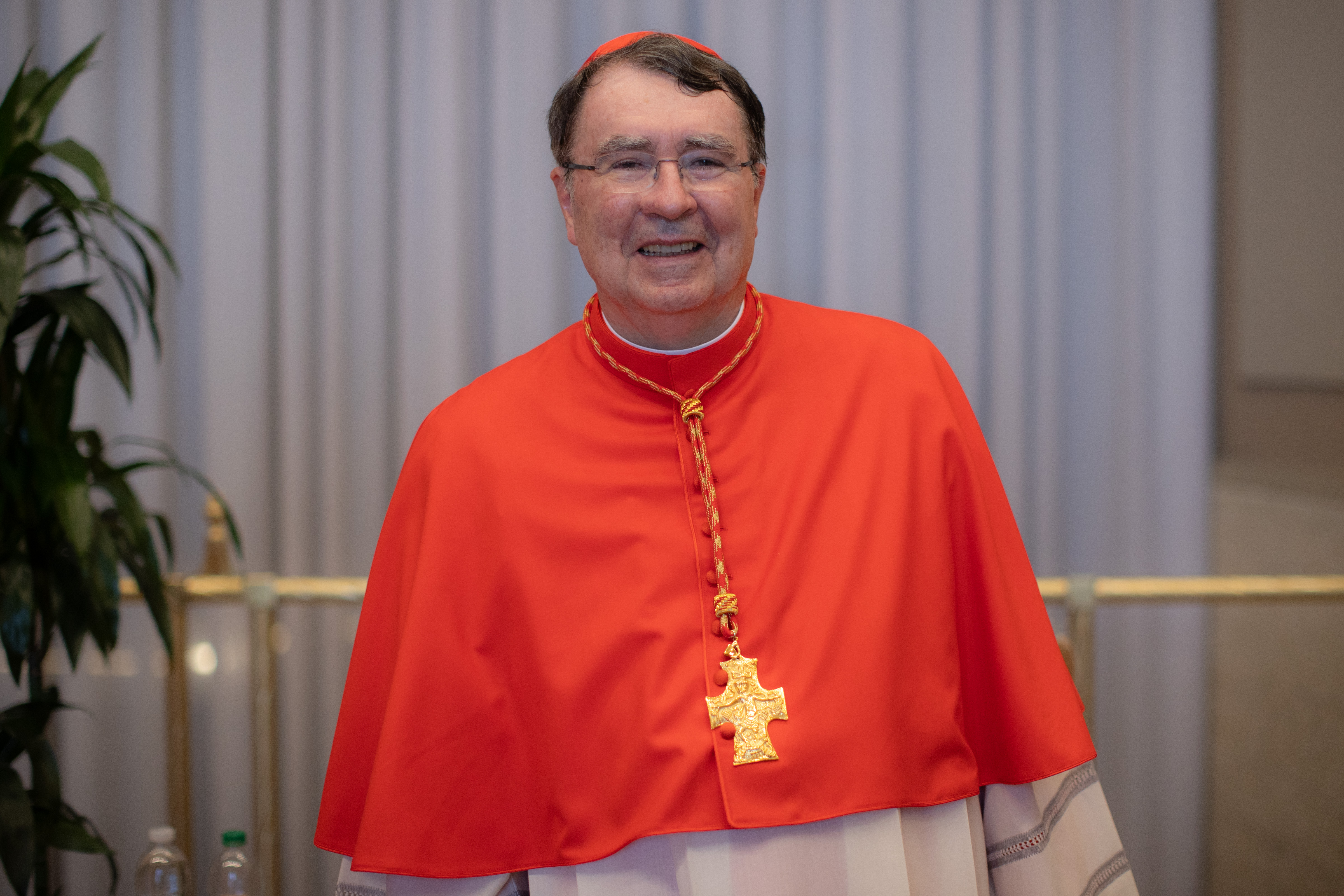
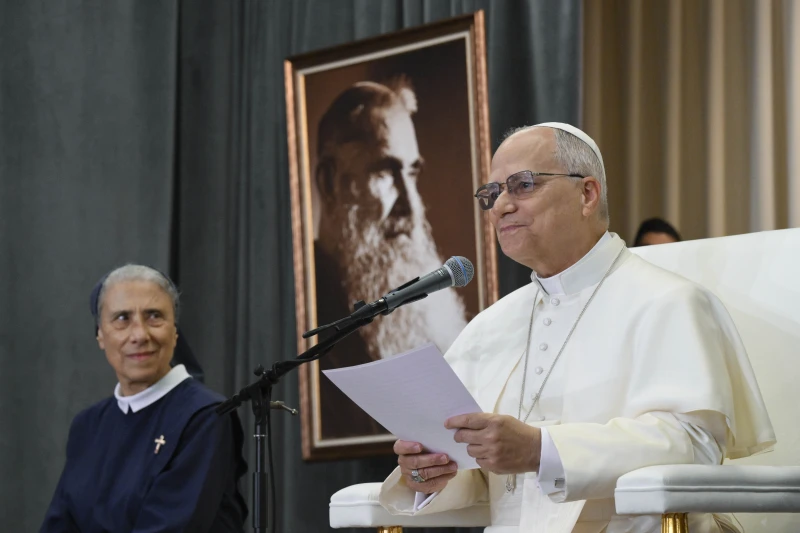 Pope Leo XIV speaks to patients and caregivers at the De La Croix Hospital in Jal el Dib, Lebanon, on Dec. 2, 2025. / Credit: Vatican Media
Vatican City, Dec 18, 2025 / 18:28 pm (CNA).
Pope Leo XIV warned against the destructive spiral fueled by the arms race and the development of autonomous weapons, and called for an “unarmed and disarming” peace — one that springs from the resurrection of Christ — as the only answer to the world’s challenges.
“The peace of the risen Jesus is unarmed, because his was an unarmed struggle in the midst of concrete historical, political, and social circumstances,” the pontiff wrote in his message for the 59th World Day of Peace, which will be celebrated on Jan. 1, 2026. Its text was released Dec. 18 by the Holy See Press Office.
The four-page document is titled “Peace Be with You All: Towards an Unarmed and Disarming Peace,” an expression that directly echoes the first words spoken by Leo XIV after his election as the successor of Peter on May 8, when he appeared on the balcony of the Apostolic Palace to greet the faithful for the first time.
In the text, the pope lamented that, in the face of global challenges, the predominant response is an “enormous economic investment in rearmament.” In this regard, he noted that in 2024, global military spending increased by 9.4% compared with the previous year, confirming “the trend of the last 10 years.” According to the data cited, total spending reached $2.718 trillion, equivalent to 2.5% of the world’s gross domestic product.
Beyond the statistics, the pope warned of the cultural and educational consequences of this logic. He criticized the fact that schools and universities are not adequately preserving “a culture of memory” that remembers the “millions of victims” of wars and lamented that, instead, educational programs are being promoted that are based on the “perception of threats,” promoting “only an armed notion of defense and security.”
The Holy Father also emphasized how technological advancements and the incorporation of artificial intelligence in the military sphere have “worsened the tragedy” of armed conflicts. He therefore warned of the risk of a growing tendency to “shirk responsibility” by political and military leaders such that “decisions about life and death are increasingly “‘delegated’ to machines.”
In his view, this is an “unprecedented destructive betrayal” of the “legal and philosophical principles of humanism” upon which any civilization is based and safeguarded.
The pontiff did not shy away from denouncing “the enormous concentrations of private economic and financial interests” that are driving states in this direction, but emphasized that just criticizing this would not be enough “unless we also awakened conscience and critical thought” throughout society.
In his reflection, Leo XIV included an explicit warning against the religious instrumentalization of violence. The pope observed that it is part of the contemporary landscape to “to drag the language of faith into political battles, to bless nationalism, and to justify violence and armed struggle in the name of religion.” In response, he urged believers to “actively refute this, above all by the witness of their lives,” because “these forms of blasphemy profane the holy name of God.”
Therefore, he emphasized that, alongside concrete actions for peace, it is increasingly necessary to cultivate “prayer, spirituality, and ecumenical and interreligious dialogue” as authentic paths to peace and as languages of encounter between traditions and cultures.
The Holy Father also warned of the risk of treating peace as a “distant ideal” and “disconnected from the concrete experience of people and the political life of nations.”
When peace is presented as something unattainable, the pope noted in the text, “we cease to be scandalized when it is denied, or even when war is waged in its name.”
According to the pontiff, there is a real risk that this logic will end up seeping into both private and public life, fueling the perception that it is almost “a fault” not to be sufficiently prepared for war, “not to react to attacks,” even going “far beyond the principle of legitimate defense.”
“It is no coincidence that repeated calls to increase military spending, and the choices that follow, are presented by many government leaders as a justified response to external threats,” Leo XIV lamented.
Indeed, he continued, “the deterrent power of military might, especially nuclear deterrence, is based on the irrationality of relations between nations, built not on law, justice, and trust but on fear and domination by force.”
Faced with this scenario, the pope proposed a different understanding of peace that “wants to dwell within us” and has the “gentle power to enlighten and expand our understanding; it resists and overcomes violence.”
‘Peace is a breath of the eternal’
“Peace is a breath of the eternal: while to evil we cry out ‘Enough,’ to peace we whisper ‘Forever,’” the pope emphasized.
The reflection included a cultural critique of the modern world, which he called “realistic” in its narratives but “devoid of hope, blind to the beauty of others,” and that forgets that “God’s grace is always at work in human hearts, even those wounded by sin.”
In this regard, the pope recalled that the path proposed by Jesus was already perplexing even for his own disciples: “The Gospels do not hide the fact that what troubled the disciples was his nonviolent response,” a path that everyone, starting with Peter, opposed, “yet the Master asked them to follow this path to the end. The way of Jesus continues to cause unease and fear.”
The Holy Father acknowledged the discouragement experienced by people of goodwill who “have hearts ready for peace” and are overwhelmed by a feeling of “powerlessness” in the face of the increasingly uncertain course of events.
The World Day of Peace was instituted by St. Paul VI, who proposed it on Dec. 8, 1967, the solemnity of the Immaculate Conception. It was celebrated for the first time on Jan. 1, 1968, coinciding with the solemnity of Mary, Mother of God, and since then it has become an annual occasion for the Church to reflect on the great challenges of human coexistence.
This story was first published by ACI Prensa, CNA’s Spanish-language news partner. It has been translated and adapted by CNA.