
For an OFW, Success and Sacrifice Are the Same Story
People often ask whether working abroad has made you successful. You may not know how to answer immediately. If success means wearing expensive clothes, driving a luxury car, or posting photographs in beautiful places, you may not feel very successful.
 Ms Pauline - Senior News Editor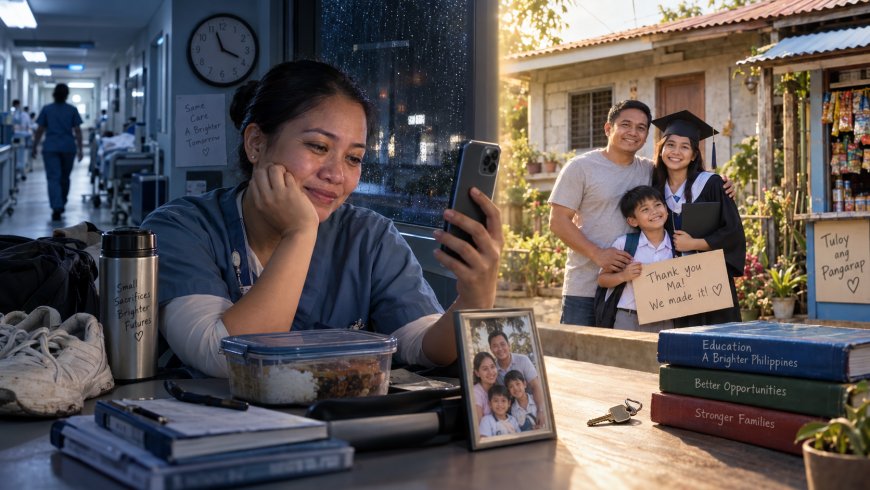
Most of your clothes may have been bought during a sale.
And many of the beautiful places in your photos may have been visited during your only free afternoon, while you were already worrying about work the next day.
But if success means giving your family a better life, then yes, you can say that you succeeded.
The problem is that people often see your success without seeing the sacrifice behind it.
They do not see the small room where you lived abroad.
They do not see the birthdays, school programs, family dinners, and Christmas celebrations you missed.
They see the balikbayan boxes filled with chocolates, clothes, perfume, and gifts.
For you, success and sacrifice are not two separate stories.
They are the same story.
You left the Philippines carrying your own dreams, but you also carried the dreams of the people you loved.
You wanted your children to finish school.
You wanted your parents to have medicine.
You wanted your family to live in a home where rain stayed outside instead of entering through the roof.
You wanted bills to become ordinary pieces of paper, not reasons for everyone to panic.
So you left.
At the airport, you told them, “Do not worry about me.”
That may have been your first sacrifice.
You made your family believe you were brave even while fear was filling your chest.
Like many OFWs, you became an excellent actor at the airport.
You smiled while your heart was breaking.
You waved confidently while wondering whether you were making the right decision.
When you arrived abroad, almost everything felt unfamiliar.
The language was different.
The weather was different.
The food was different.
Even the washing machine seemed to require a university degree.
You learned quickly because you had no choice.
You smiled when you were confused.
You nodded when you did not fully understand.
As long as your salary arrived correctly, you learned to forgive people for mispronouncing your name.
You worked long hours.
You accepted overtime.
You worked on weekends while other people rested.
Not because you enjoyed giving up your free time, but because every extra hour had a purpose.
One hour became electricity.
Another became tuition.
A weekend shift became medicine.
Overtime became a roof, a refrigerator, a school uniform, or the final payment on a debt.
Your salary rarely felt like your own.
Before it even entered your account, it already had many owners.
Rent.
And sometimes, one more emergency that was apparently more urgent than the first two.
Whatever remained was for you.
Sometimes it was just enough for instant noodles, coffee, and the courage to continue.
You learned that an OFW could survive almost anything with Wi-Fi, a rice cooker, and one Filipino friend who knew where to find the cheapest groceries.
But loneliness was harder to manage.
You could budget your salary.
You could not budget your homesickness.
It arrived without warning.
You watched your children grow through photographs.
You listened to your family laughing from a phone placed at the end of a dining table.
Then the call ended, and your room became quiet again.
That silence was part of the real cost of working abroad.
Sacrifice was not only about hard work.
It was also about absence.
Life continued at home while you were away.
Your children became taller.
There were nights when you questioned your decision.
You wondered whether the money you sent could ever replace the time you were losing.
But every time you wanted to give up, you remembered why you had left.
You remembered the unpaid bills.
So you stayed.
Year after year, you stayed.
Slowly, things began to change.
The debts became smaller.
The house became safer.
Your parents could buy their medicine.
There was food in the refrigerator.
Your family no longer panicked every time an unexpected expense appeared.
Then one day, your child graduated.
You watched the ceremony from abroad.
When your child’s name was called, you stood up alone in your small room as though you were inside the auditorium.
You clapped.
At that moment, every missed birthday came back to you.
Every lonely Christmas.
Every cheap meal.
Every night when you wanted to give up but chose to continue.
Suddenly, all your sacrifices were standing on a stage wearing a graduation gown.
That was when you finally understood success.
Success was not the diploma in your own hand.
It was seeing the diploma in your child’s hand.
It was knowing that your loneliness had created an opportunity for someone you loved.
But success also taught you an important lesson.
Sacrifice should not destroy the person making it.
For many years, you may have believed that being a good provider meant giving everything away.
You thought you had to say yes to every request.
You felt guilty whenever you bought something for yourself.
Even ordering dessert felt like betraying the family budget.
Then you realized that you also needed a future.
You could not spend twenty or thirty years abroad helping everyone, only to return home with no savings, no income, and no plan.
That would not be success.
That would be sacrifice without protection.
So you began saving.
At first, the amount may have been small.
You learned to invest carefully.
You started preparing for retirement.
Most importantly, you learned to say no.
The first time you refused an unnecessary request, you probably felt terrible.
You may have thought the family would declare a national emergency.
But the relative survived.
The birthday party continued.
And the world did not end.
You discovered that saying no did not mean you loved your family less.
It meant you were protecting yourself, so that one day, you would not become the next family emergency.
True success is not having relatives believe you are rich.
It is having peace.
It is knowing that your family is safe.
It is having savings under your own name.
It is being able to choose whether to stay abroad or return home.
Not because of desperation.
Not because another bill has arrived.
But because you are finally ready.
You do not need to pretend that the sacrifice was easy.
You missed too much.
There are years you can never recover.
There were moments when your children needed your presence, not your remittance.
There were times when your parents needed a hand to hold, not another package from overseas.
Those are the painful truths of your life as an OFW.
But your sacrifice also created something meaningful.
You turned loneliness into education.
You turned overtime into medicine.
You turned homesickness into a safer home.
You turned distance into opportunity.
You turned the years you gave away into a better future for the people you loved.
That is the real relationship between sacrifice and success.
Success is not the absence of pain.
It is when the pain produces something meaningful.
Sacrifice is not proof that you failed to enjoy life.
It is proof that you carried something difficult for a reason greater than yourself.
But sacrifice should not continue forever.
There must come a time when the dream includes you.
A time for rest.
A time when you can sit at the table without checking the date of your next flight.
Your greatest success is not sending money home until old age.
It is building a life strong enough that you can finally stop leaving.
Are you successful?
Not because you became rich.
Not because you impressed people.
Not because you returned with expensive gifts.
You are successful because your family received opportunities they once only prayed for.
Was the sacrifice worth it?
Yes, but not because it did not hurt.
It was worth it because the pain had a purpose.
You may wish success had not required so much distance.
You may wish you had not missed so many important moments.
You may wish love alone could have paid the bills while allowing you to remain at home.
But life did not give you a perfect choice.
It gave you a difficult one.
And you chose to sacrifice because you believed that one day, the people you loved would live better.
Now, when you look at the house, the diplomas, the medicine, the savings, and the hope in your family’s eyes, you understand what success truly means.
It is not what you were able to buy.
And one day, when you finally return home for good, you will carry no greater proof than the life you built together.
You will look at your family and quietly say:
“This was my sacrifice.