Love in Two Time Zones: How OFW Couples Keep the Relationship Alive
Long-distance love is already complicated. Add different time zones, unstable Wi-Fi, overtime work, family expenses, jealousy, and one partner who replies only with “Okay,” and the relationship can begin to feel like an international peace negotiation. For many OFW couples, love is not measured by how often they hold hands.
 Ms Pauline - Senior News Editor
It is measured by how many times they ask:
“Gising ka pa?”
Sometimes the answer is yes.
Sometimes the answer arrives six hours later.
And sometimes the person was clearly online but somehow did not see the message.
This is where imagination becomes dangerous.
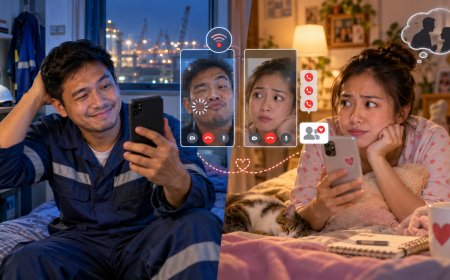
When One Says Good Morning and the Other Says Good Night
In a normal relationship, couples can eat dinner together.
In an OFW relationship, one is eating breakfast while the other is removing makeup, changing clothes, or trying not to fall asleep during a video call.
“Good morning, love.”
“Good night.”
“Why do you sound tired?”
“Because it is midnight.”
“Are you not happy to talk to me?”
And suddenly, sleep becomes evidence of emotional neglect.
Time zones can make communication difficult, but successful OFW couples learn to adjust.
They do not expect unlimited access to each other.
They agree on a schedule.
They understand that work hours are not romantic hours.
They also learn that a five-minute call with full attention can be more meaningful than a one-hour call where one person is scrolling through Facebook and the other is washing dishes.
The Morning Report
Many OFW relationships begin each day with what looks like a daily office report.
“Good morning.”
“Have you eaten?”
“Where are you going?”
“Who are you with?”
“What time will you be home?”
The questions are not always controlling.
Sometimes they are simply the long-distance version of affection.
When couples live apart, small updates help them feel included.
A photo of lunch.
A message from the bus.
A quick call during a break.
A picture of the children doing homework.
These ordinary details create connection.
But there is a difference between staying connected and conducting surveillance.
Love should not require live location, three character references, and a photograph holding today’s newspaper.
Trust is still necessary.
Even when the internet is fast.
Especially when the imagination is faster.
The Dangerous Blue Check Mark
Few things are more powerful in a long-distance relationship than the blue check mark.
It says:
Your message was seen.
But it does not explain why there was no reply.
Perhaps the OFW was busy with a customer.
Perhaps the phone was placed in a locker.
Perhaps the partner at home opened the message while carrying groceries.
But after ten minutes of silence, the brain begins writing its own story.
“He saw my message.”
“He ignored me.”
“He has changed.”
“He probably has another family.”
By the end of the hour, the relationship has already ended, the property has been divided, and the imaginary third party has been identified through Facebook.
Then the reply arrives:
“Sorry, I was in the shower.”
This is why OFW couples must learn not to treat every delayed response as betrayal.
Sometimes silence is not a secret.
Sometimes silence is simply poor timing.
For many OFWs, sending money is one of the clearest ways they show love.
The remittance pays for food, school, rent, medicine, electricity, and family emergencies that mysteriously appear two days before salary.
The OFW may say:
“I miss you.”
The family replies:
“We miss you too. Also, the washing machine stopped working.”
Romance and appliances often live in the same conversation.
But money can also create misunderstandings.
The OFW may feel that nobody asks whether they are tired, only whether the remittance has arrived.
The partner at home may feel guilty for always discussing expenses.
Both may feel unappreciated.
A relationship becomes unhealthy when one person is treated only as a provider and the other is treated only as a caretaker.
The OFW is not an ATM.
The partner at home is not a household employee.
Both are people carrying different forms of loneliness.
Jealousy travels easily.
It does not need a visa.
It does not experience flight delays.
A new Facebook friend can cause suspicion.
A heart reaction can create an argument.
A group photo can become a criminal investigation.
“Who is the man beside you?”
“My supervisor.”
“Why is he smiling?”
“Because it was a Christmas party.”
“Why were you also smiling?”
At some point, even smiling becomes suspicious.
But jealousy is often not about another person.
It is about fear.
Fear of being forgotten.
Fear of being replaced.
Fear that distance has changed the relationship.
The healthiest OFW couples do not mock these fears, but they also do not allow fear to control everything.
They reassure each other.
They explain calmly.
They avoid unnecessary secrecy.
And most importantly, they do not use jealousy as proof of love.
Constant suspicion is not romance.
It is emotional exhaustion with mobile data.
When Arguments Happen Through Chat
Chat messages are convenient, but they are terrible at expressing tone.
Consider the word:
“Fine.”
In normal English, it may mean everything is okay.
In a Filipino relationship, it may mean the exact opposite.
“Okay.”
This can be peaceful.
Or dangerous.
“K.”
This can signal the collapse of diplomatic relations.
Long-distance couples often fight over words that would sound harmless in person.
One is tired.
The other feels ignored.
One sends a short reply.
The other interprets it as coldness.
Soon, they are arguing about the way “good night” was typed.
The better solution is simple:
Call.
Serious problems should not be solved through punctuation.
When voices are heard, people remember there is a human being on the other side.
Not an enemy.
Not a suspect.
Not a blue check mark.
A person.
The Children Also Feel the Distance
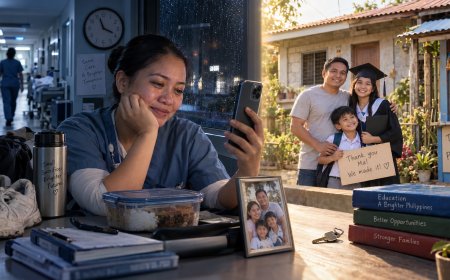
For OFW parents, the deepest pain is often not romantic loneliness.
It is missing the children.
Birthdays are watched through screens.
School awards are celebrated through photos.
First steps, first words, and first heartbreaks may happen while a parent is abroad.
Sometimes the child does not want to talk.
Sometimes the child says:
“Who is that?”
The parent laughs.
Then cries after the call.
Children may not understand why Mama or Papa had to leave.
They only understand absence.
This is why the parent at home must help maintain the connection.
Tell stories.
Show pictures.
Include the OFW in decisions.
Let the child hear the parent’s voice regularly.
The relationship should not begin only when the balikbayan box arrives.
Homecoming Is Not Always Like the Movies
Airport reunions are emotional.
There are hugs, tears, flowers, and photographs.
But after the dramatic arrival comes real life.
The OFW discovers that the children have new routines.
The partner has become more independent.
The household operates differently.
Even the bed may feel unfamiliar.
One person expects romance.
The other is jet-lagged and wants to sleep.
One expects gratitude.
The other wants help fixing the broken kitchen cabinet.
Reunion requires patience.
Couples may need time to become comfortable again.
Love does not instantly return to normal just because the flight has landed.
Sometimes people must learn how to live together again.
OFW relationships survive when both people stop asking only:
“Do you still love me?”
And begin asking:
“How can I make you feel loved from here?”
The answer may be a regular call.
An honest discussion about money.
A planned visit.
A surprise meal delivery.
A handwritten letter.
A prayer said together.
A simple message before work.
Couples also need a shared future.
Long-distance love becomes harder when there is no clear plan.
How long will the OFW stay abroad?
What are they saving for?
When will they live together again?
Sacrifice becomes more bearable when it has direction.
The Meaning Behind “Have You Eaten?”
Filipino couples do not always express love through dramatic speeches.
Sometimes the greatest declaration is:
“Kumain ka na?”
It means:
I remember you.
I worry about you.
I know you are tired.
Please take care of yourself because I cannot be there.
Long-distance love is made of these small questions.
It survives missed calls, delayed messages, weak signals, expensive flights, and misunderstandings.
It survives because two people keep choosing each other—even when choosing each other must be done through a screen.
And perhaps that is the most beautiful part of OFW love.
It is not perfect.
It is not easy.
It is sometimes funny, sometimes painful, and frequently interrupted by bad Wi-Fi.
But when it is built on trust, honesty, patience, and a plan to reunite, distance does not destroy love.
It teaches love how to travel.